
Characteristics of Titanium
![[Ti]Titanium: atomic number 22; atomic mass 47.867](/en/product/img/titan_feature_im01.webp)
Titanium is well known for its properties of lightness, strength, and high-corrosion-resistance, but it is not so well known that there are other propertiess and what they are really capable of. Titanium is a 'new' metal that was discovered in 1790 and started to be produced industrially in 1948 after a long period of matuaration since its discovery. Because of its bountiful reserves and excellent bio-friendliness, titanium is a material friendly to the environment and humans. Through research and development this material has revealed neally infinite possibilities one after another.
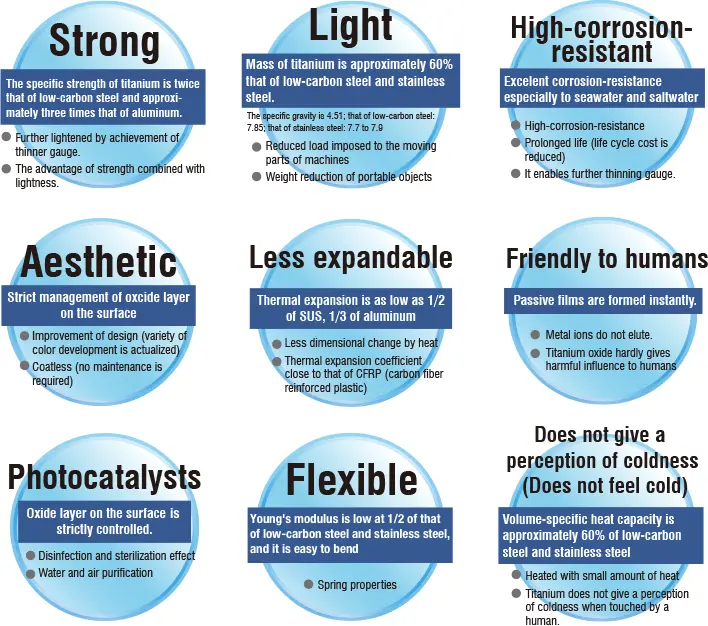
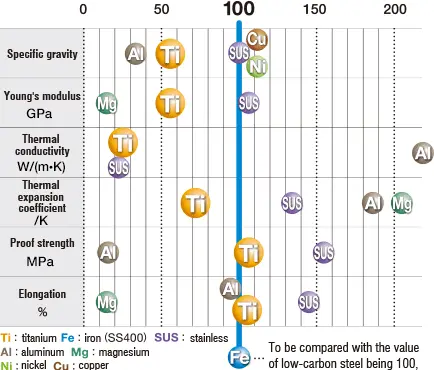
Relative Comparison Between Titanium and Typical Metals
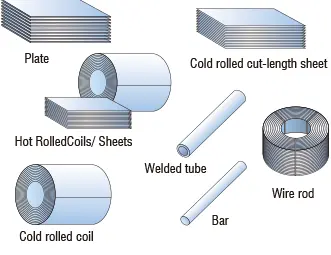
Processability of Titanium
- 1Titanium with formability in accordance with JIS class1 can be formed using almost the same tools, jigs, or machines as those for low-carbon steel and stainless steel. It also has excellent deep drawability.
- 2It can be seam-welded or spot-welded in the similar method as stainless steel in the atmosphere. For general welding (mainly by TIG welding), argon for its shield gas and other appropriate welding management are required. There is no concern about corrosion of welded portions nor stress corrosion cracking.
Economical Efficiency of Titanium
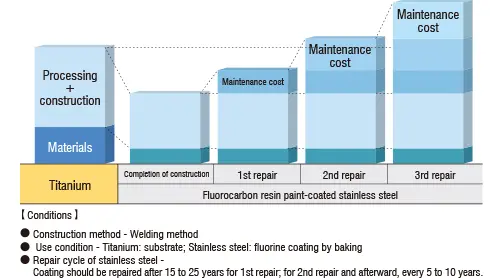
(roof materials).
- Unit price per mass is more expensive than that of low-carbon steel and stainless steel, but titanium's low specific gravity reduces the difference per volume.
- Also, reduction in thickness of gauge is possible by virtue of its high specific strength and high-corrosion-resistance, which are sufficiently beneficial to users, taking into consideration reduced life cycle costs due to reduced maintenance costs.
- For example, there are several advantages in using titanium as building material products (roofs and exterior walls) such as optimized construction efficiency and improved aseismic performance due to reduction of mass as well as the advantage of reduced life cycle costs.
Type of Titanium and the Standards
| Category | typical chemical compositions | properties |
|---|---|---|
| Commercially pure titanium | JIS class 1 to 4 / ASTM GR 1 to 4 | Good formability (Grade 1) Relatively high strength (Grade 4, TS=700MPa) |
| Low alloyed corrosion resistant titanium | Ti-0.15Pd | high corrosion resistance |
| α type titanium alloy | Ti-5Al-2.5Sn | Good creep resistance Good weldability |
| α + β type titanium alloy | Ti-6Al-4V Ti-5Al-1Fe* Ti-5Al-2Fe-3Mo* |
Age-hardenability Difficult to be cold-formed |
| β type titanium alloy | Ti-15V-3Al-3Cr-3Sn Ti-20V-4Al-1Sn* |
Age-hardenability Cold formable |
- * Nippon Steel's original alloys
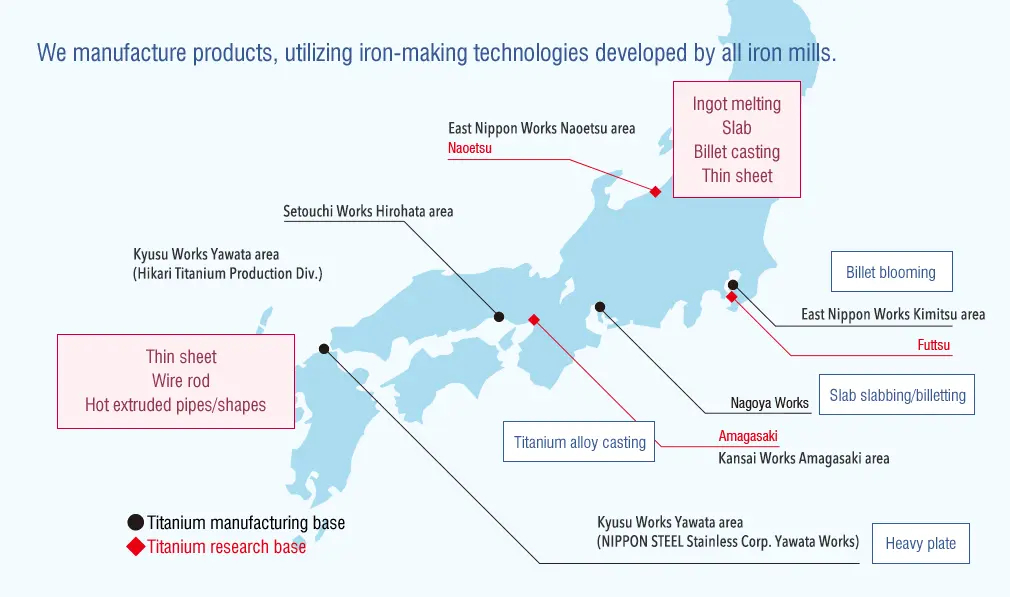
Nippon Steel's Titanium Manufacturing/Research Base
For further product information
Product Quotes, and inquiries without complete information required in inquiry form may not be responded to. Selection of inquiries for reply online is at the sole discretion of Nippon Steel. We appreciate your understanding.