
Action to Implement Management that is Conscious of Cost of Capital and Stock Price
Basic approach to improving the PBR share price indicator
The Tokyo Stock Exchange requires companies whose price-book value ratio (PBR) consistently falls below 1.0 to disclose their capital efficiency improvement initiatives and the progress thereof.
Nippon Steel manages its business with a focus on the cost of capital and share price performance, while incorporating capital market perspectives, with the aim of enhancing corporate value over the medium to long term. We believe what it takes to enhance corporate value includes making proactive growth investments to realize sustainable profit growth while ensuring capital efficiency and financial soundness from a medium- to long-term perspective, as well as earning appropriate market recognition for the Company’s growth potential, business stability and sustainability.
In the 2030 Medium- to Long-term Management Plan, we will make 6-trillion-yen growth investments over the five-year period, achieving an underlying profit of 1 trillion yen, an ROE of around 10%, a D/E ratio of around 0.7, and a debt/EBITDA ratio of 3.5 times or less in FY2030. Through these initiatives, we aim to deliver sustained growth in EPS.
We will continue to enhance market understanding of these initiatives through proactive dialogue and disclosure.
Recognition of issues and approaches to be taken (Approaches from both ROE and PER perspectives)
Current status of ROE and approaches to be taken
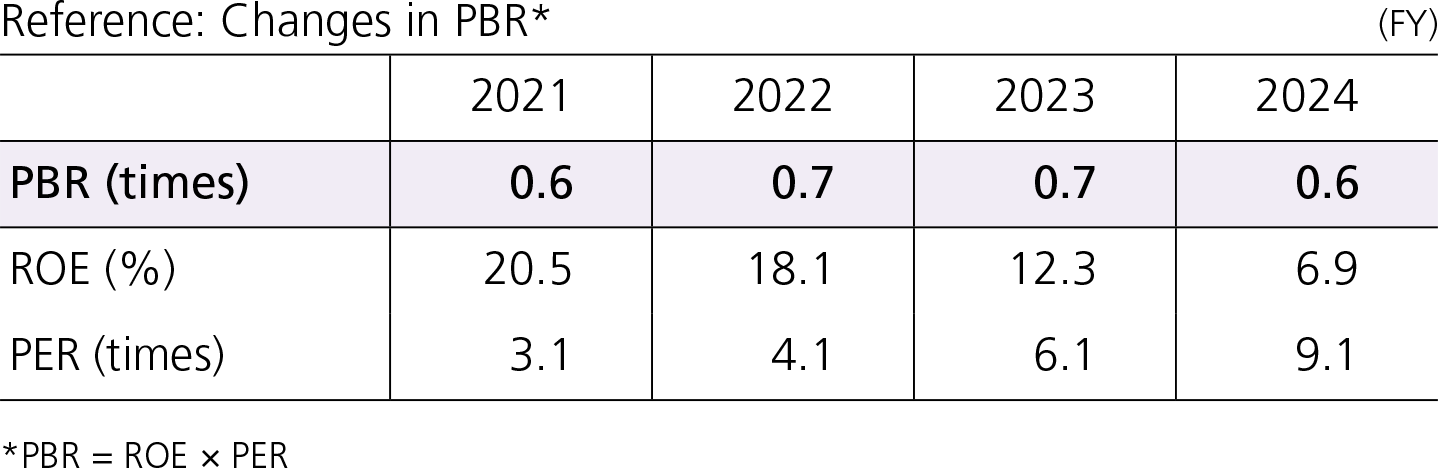
We target an ROE of around 10% for FY2030 in the 2030 Medium- to Long-term Management Plan. While our ROE exceeded 10% from FY2021 to FY2023, the most recent ROE stands below 10%. The decline in ROE is partly attributable to temporary inventory valuation losses and one-off costs associated with the acquisition of U. S. Steel. More fundamentally, however, the earnings contribution from our overseas growth strategy and domestic group restructuring has not yet been fully realized. Going forward, we will deliver earnings growth by realizing the benefits of our growth investments, including U. S. Steel, thereby improving ROE. From the perspectives of maintaining financial soundness and securing reliable access to funding at an appropriate cost, we believe a D/E ratio of around 0.7 is appropriate for our capital structure. Although the current ROE is below 10%, we will continue to make growth investments in the 2030 Medium- to Longterm Management Plan and drive profit growth by realizing the benefits of these investments. As a result, we aim for an ROE of around 10% for FY2030 and 10% or higher from FY2031 onward, when the benefits of our investments are expected to be fully realized.
Current status of PER and approaches to be taken
Although our PER has shown a slight upward trend in recent years, it remains at a low level compared to the average of around 20 times for companies listed on the Tokyo Stock Exchange Prime Market. We believe that PER reflects market expectations for earnings growth as well as the cost of capital.
(1) Profit growth rate
Under the 2030 Medium- to Long-term Management Plan, Nippon Steel aims to increase underlying profit from the FY2026 forecast of ¥700 billion to ¥1 trillion by FY2030. Assuming that items other than underlying profit (such as inventory valuation differences, non-operating items, consolidation adjustments, interest expenses, and items subject to separate disclosure) remain at the same level as forecasted for FY2026, net profit is expected to increase from 280 billion yen forecasted for FY2026 to approximately 490 billion yen for FY2030. In the same period, EPS is expected to increase from ¥55 per share to approximately ¥80 per share, representing annual growth of roughly 10%, even assuming full conversion of the outstanding convertible bonds.
A key driver of earnings growth will be the realization of operational synergies and the benefits of capital investments at U. S. Steel. We have already deployed approximately 100 employees to U. S. Steel, and operational synergies are already beginning to materialize. In addition, the capital investment projects currently being implemented at U. S. Steel are based on technologies and initiatives with a proven track record in Japan, giving us a high level of confidence that the expected benefits will be realized. We will continue to engage proactively with the market and communicate the drivers of earnings growth in order to build confidence in the achievability of our growth targets.
(2) Cost of capital Cost of capital
We believe that our cost of capital reflects the following market perceptions and concerns. (A) The capital markets recognize that the steel industry is susceptible to significant earnings volatility and sensitive to economic conditions (B) The capital markets recognize that the steel industry is highly influenced by Chinese supply-demand conditions and government policies (C) The capital markets are concerned that achieving carbon neutrality in the steel industry will require massive investments and higher operating costs, creating uncertainty over future profitability and the recoverability of those investments.
Nippon Steel has sought to strengthen its resilience to changes in the external environment while steadily translating growth opportunities into earnings growth. To achieve this, we have strengthened the earnings base of our domestic business and expanded our business portfolio into overseas markets as well as upstream and downstream areas of the steel supply chain.
Specifically, we reduced the break-even point for our domestic steel business by about 40% by reducing fixed costs through measures to optimize the structure of production facilities, establishing a mechanism under which fluctuations in externally procured raw material and fuel costs are reflected in prices for sales to specific customers segment and shared across the supply chain, and improving the product mix and order mix. Furthermore, by increasing our investment in the raw materials business, we have established a revenue structure that has allowed us to offset cost increases resulting from fluctuations in raw material prices with profits from that business. At the same time, by bringing distribution activities into our business portfolio, we have expanded our presence across upstream and downstream segments of the steel supply chain. Moreover, we have sought to maximize synergies through the reorganization of our steel group companies.
In expanding our business overseas, we have concentrated our management resources on our priority regions, the U.S., Europe, India, and Thailand, from the perspectives of “areas where steady demand growth is expected” and “areas where our technology and product capability can be leveraged.” Against the backdrop of rising nationalism and protectionist trade policies, we are focusing on our investment, particularly in the U.S., Europe, and India, as growth markets less exposed to the impact of imbalances in Chinese steel supply and demand. Building on the acquisition of G/GJ Steel in Thailand, our top-priority home market in the ASEAN region, we are reinforcing our business foundation and expanding our share in the steel sheet market. U. S. Steel is expected to emerge as the primary earnings driver of the Group in FY2026 and will play a central role in accelerating earnings growth in our overseas business.
Through these initiatives, we have expanded the depth of our operations in upstream and downstream segments and broadened the width of our overseas operations, developing a more resilient business structure with broader geographic exposure and a stronger presence across the steel value chain. As a result, we have built a revenue structure that enables us to consistently generate an underlying business profit of at least 600 billion yen by enhancing our resilience to fluctuations in domestic and international demand, raw material prices, and changes in regional market conditions, without being significantly affected by external factors. Despite the deteriorating external environment, including the impact of the Middle East situation, we expect to generate an underlying business profit of at least ¥700 billion for FY2026. This demonstrates that the reforms to our earnings structure and business portfolio are beginning to deliver tangible results.
Meanwhile, achieving carbon neutrality is a long-term endeavor. While communicating that technological development toward carbon neutrality is progressing steadily, we make it clear that any investment in carbon neutrality following the completion of such development is contingent upon ensuring the predictability of investment recovery. In other words, we clearly state the need to establish a GX Steel market where the value of steel products with low CO2 emissions is properly recognized, and their additional costs can be reflected in the selling prices. We also communicate our efforts to work with governments, relevant organizations and customers to help establish such a market.
We believe that enhancing market understanding of these initiatives through sustained dialogue and communication will contribute to lowering our cost of capital and improving our PER. We will continue to strengthen engagement through our integrated reports, enhance the content of our earnings presentation materials, expand our IR activities for individual investors, and deepen dialogue with institutional investors in Japan and overseas.