
Successful Test Production of Direct Reduced Iron from Low-Grade Iron Ore Using 100% Hydrogen
Nippon Steel Corporation
Nippon Steel Corporation ("Nippon Steel") has successfully conducted a direct reduction test using 100% hydrogen as the reducing agent at the pilot-scale shaft furnace of its Hasaki Research & Development Center (furnace height approx. 60m, production capacity 1 t/h, commenced operation in March 2026). The test utilized a lower-grade iron ore (blast furnace grade pellets) than conventional high-grade iron ore (direct reduction grade pellets) as raw material, conducting over 300 hours of continuous operation and producing a cumulative total of over 1,000 tonnes of Direct Reduced Iron (DRI).
This achievement was made possible by addressing technical challenges—specifically, the endothermic characteristics associated with reduction reactions using hydrogen alone and the powdering tendency of low-grade iron ore—thereby ensuring stable production of DRI. This marks a major step forward toward the commercialization of "Production of direct reduced iron using hydrogen," a breakthrough ironmaking technology aimed at achieving a carbon-neutral society.
Based on the "Nippon Steel Carbon Neutral Vision 2050," Nippon Steel is promoting the development of three breakthrough technologies with government support*: "High-grade steel production in large-scale electric arc furnaces (EAFs)," "Hydrogen reduction in blast furnaces (BFs)," and "Production of DRI using hydrogen." "Production of DRI using hydrogen" is a technology that produces DRI in a reduction furnace using hydrogen as the reducing agent, rather than through the blast furnace process. It is a revolutionary technology capable of significantly reducing CO2 emissions from the ironmaking process.
Currently, approximately 100 million tonnes of DRI are produced annually worldwide using commercial reduction furnaces powered by natural gas. Because natural gas reduction emits CO2, the development of hydrogen reduction technology is crucial for decarbonization. However, reduction using hydrogen alone is an endothermic reaction, which causes the internal furnace temperature to drop easily. Achieving stable reduction operations requires advanced thermal compensation technology to properly maintain the internal furnace temperature.
Furthermore, existing commercial reduction furnaces operate on the assumption that high-grade iron ore with high iron content and minimal impurities will be used. However, the supply of high-grade iron ore is limited. From the perspective of securing future iron ore sources, it is essential to establish technology that can utilize abundant low-grade iron ore. Nevertheless, low-grade iron ore is prone to powdering during reduction, which adversely affects gas permeability inside the furnace and reaction control. Consequently, its utilization has posed a significant technical hurdle.
In this initiative, Nippon Steel achieved stable operation in the pilot-scale shaft furnace by applying an optimal thermal compensation technology designed for the endothermic reaction during direct hydrogen reduction, alongside operational techniques that suppress the powdering of low-grade iron ore.
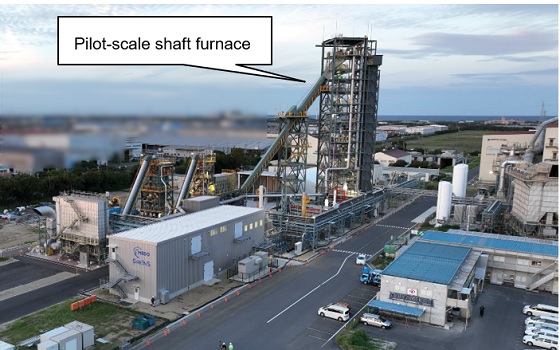
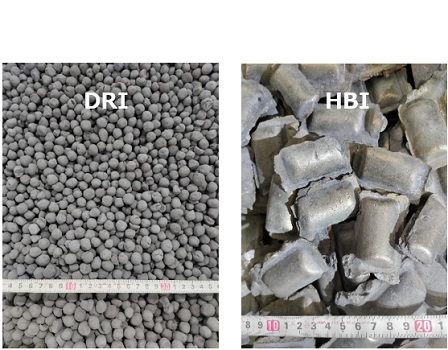
Nippon Steel will continue its "Production of direct reduced iron using hydrogen" tests at the pilot-scale shaft furnace to establish direct reduction technology and optimize operational conditions. Furthermore, from fiscal 2027, Nippon Steel will advance development, including scale-up technologies, aiming to establish implementation technology by around 2040 and contribute to the realization of a carbon-neutral society.
*This project was selected in January 2022 for the Green Innovation Fund Project of the New Energy and Industrial Technology Development Organization (NEDO), and an expansion of the fund was approved in November 2023. Among the projects, the "Hydrogen Utilization in Iron and Steelmaking Processes / Development of Direct Hydrogen Reduction Technology that Reduces Iron Ore with Hydrogen Only" is being advanced under a consortium consisting of three organizations: Nippon Steel, JFE Steel Corporation, and the Japan Research and Development Center for Metals (JRCM).